
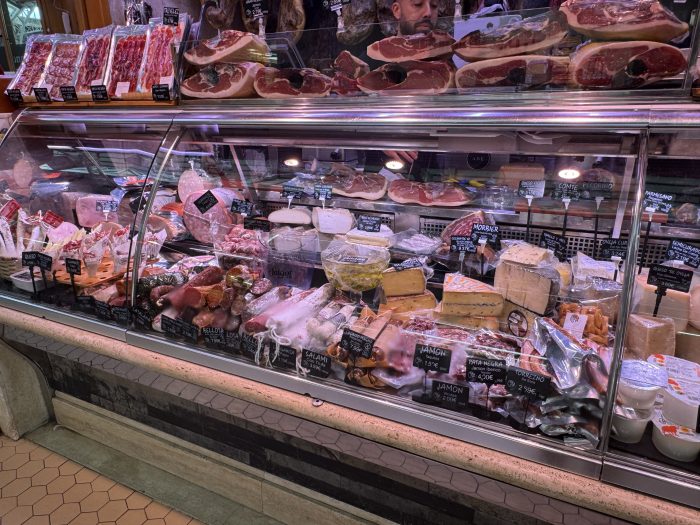
One of the first things we started buying regularly at the Central Market was charcuterie. Not because we were planning elaborate tapas spreads (though we’ve had a few), but because in Spain, charcuterie isn’t a luxury, it’s just food. You slice off a few pieces, put them on a plate, and suddenly your meal is elevated. Add a hunk of cheese and a glass of vermouth and you’re basically living your best life.
But what struck us almost immediately was the sheer variety of it all. So many kinds of jamón. So many sausages. So many names. What’s the difference between lomo and salchichón? Is sobrasada just spreadable chorizo? And are we really ready to talk about blood sausage?
Let’s break it down. Here are some of the most common and visible types of charcuterie available – there are more, but we have to start somewhere!
Jamón Serrano vs. Jamón Ibérico
This is the one everyone asks about. The answer is they’re both delicious, but they’re not the same.
- Jamón Serrano (literally “mountain ham”) is the everyday cured ham of Spain. It’s usually made from white pigs, cured for 7–12 months, and full of that familiar salty-savory flavor.
- Jamón Ibérico, on the other hand, is the upscale cousin. It comes from the Iberian black pig, often raised free-range and fattened on acorns in the oak forests of western Spain. The top-tier version is Jamón Ibérico de Bellota, which has a rich, nutty depth that borders on silky.
(Fun fact: Some of those acorns come from across the border. The Ravasqueira winery outside Évora in Portugal hosts Spanish black pig herds each autumn for some very diplomatic foraging. Even the pigs understand Iberian cooperation.)
Lomo Embuchado
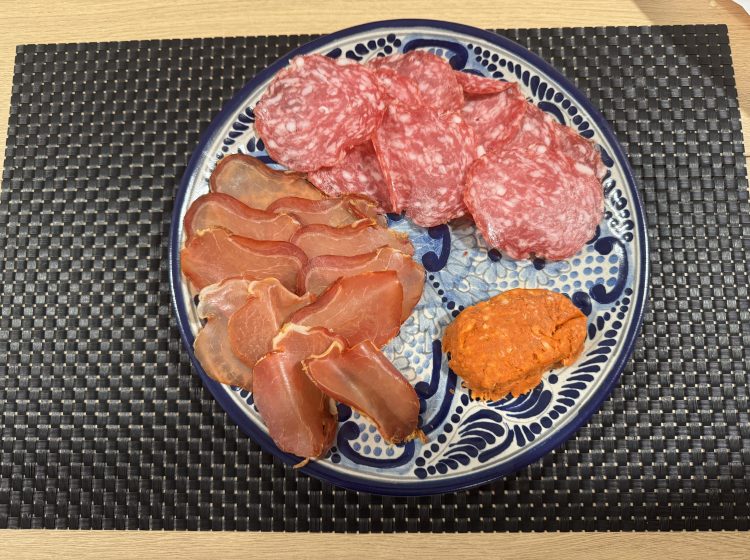
If jamón is the star of the show, lomo is the quietly confident supporting actor. This is a whole pork loin, cured with garlic and paprika, and aged until it’s firm and fragrant. It’s leaner than ham, and deeply satisfying, one of the few cuts where you taste pure meat without the fattiness. It’s one of my personal favorites.
Chorizo
Ah, chorizo. Spain’s most famous sausage. Made from ground pork, paprika (pimentón), garlic, and salt, it comes in two main varieties:
- Dulce (sweet) – rich and smoky
- Picante (spicy) – with a gentle, growing heat
It’s typically cured and sliceable, though some versions are softer and meant to be cooked.
Salchichón & Fuet
Think of these as Spain’s answer to salami. Less paprika, more black pepper and garlic. Fuet is a Catalan version. It’s long, skinny, and covered in edible white mold. Salchichón is heartier, often studded with whole peppercorns.
Morcilla (Blood Sausage)
Yes, it’s made with blood. No, you don’t need to be afraid of it. Spanish morcilla is often mixed with rice, onions, or even pine nuts, depending on the region. It’s deeply savory, soft in texture, and when done properly, utterly delicious. Pan-fried with a little apple or served alongside lentils, it’s magical.
Sobrasada
From the Balearic Islands, sobrasada is a spreadable, soft-cured sausage made with pork, paprika, and sometimes cayenne. Think of it as Spain’s answer to nduja, but sweeter, smokier, and much more likely to end up on your breakfast toast.
This is another favorite of mine, even though it’s a relatively new discovery for me. In addition to having it as a bread topping, I use the picante variety as a stand-in for the Mexican chorizo my dad used to put on his comfort-food version of paella. It’s not traditional, but it is familiar in the best way.
Cecina
Often overlooked, cecina is cured, smoked beef. It’s like a bolder, leaner prosciutto. It’s more popular in the north of Spain, particularly in León, but it’s started showing up more frequently in Valencian markets. If you like your charcuterie on the smoky side, this one’s worth a try.
So, why are there so many different types of charcuterie?
Because Spain is not a monoculture. It’s a patchwork of ancient historical kingdoms, microclimates, dialects, and food traditions. That diversity shows up clearly on the charcuterie board.
Curing methods evolved out of the necessity to preserve meat without refrigeration. But every region did it a little differently. The local climate, the availability of various different spices, and access to oak trees (for feeding pigs) all played a role.
And like Spanish wines or cheeses, many cured meats are protected by DOP (Denominación de Origen Protegida) designations. That means your Jamón Ibérico de Teruel isn’t pretending to be Jamón Ibérico de Huelva, and vice versa. It’s a form of culinary terroir and, let’s be honest, pride.
Having lived in Portugal for several years, I can’t help but compare their charcuterie with Spain. After all, Portugal has chouriço, morcela, lombo, and more. But I’ll say this: only the lombo holds up.
- Portuguese lombo is excellent. It’s tender, meaty, flavorful, and beautifully cured.
- But the chouriço is typically too coarse and fatty for my taste. There are some exceptions, like at our friend Carolina’s restaurant Tábua Rasa in Porto, but we had a hard time finding chouriço we really liked.
- And morcela tends to lean a bit on the bland side. It’s a lot less complex than its Spanish counterpart.
Don’t get me wrong – I love Portugal. But when it comes to cured meat, Spain is just doing more (and arguably better). Of course, that’s just my palate talking. If you’re Portuguese and offended, I will happily accept bribes in the form of alheiras.
Since we’ve been hitting the market on Thursdays, dinner that night is typically a mixed meat and cheese spread. We usually go for:
- A firm Idiazabal and/or Manchego
- Some lomo
- A bit of chorizo picante or salchichón
- Maybe a little bit of sobrasada on toast rounds
- Fresh bread and olives
Top it off with some vermouth or the local Bobal red wine, and it’s perfect. No occasion, no ceremony. Just good food, cured by time and tradition.
All in all, there’s something wonderfully anchoring about charcuterie. It’s humble but proud, simple but sophisticated. It connects you to the land, the animal, the history, and the people who’ve spent generations refining how to make meat taste better over time.
And in a country that takes food as seriously and joyfully as Spain does, it’s no wonder charcuterie is always nearby. At the market. In your fridge. On your plate. Ready when you are.
So, slice it thinly. Pass the bread. And raise a glass to the pig. Or the cow. Or, occasionally, the goose. (We’ll get to foie gras another day.)
 A Modern Odyssey - Expatriates in Iberia
Yum! Can’t wait for Thursday charcuterie!🍷🍷🍷
LikeLiked by 1 person
Absolutely adored this one, Phil! I’m asking your permission to use this particular blog in my upcoming book, Fado & Flamenco: Living Abroad in Portugal and Spain, the last of my Iberian trilogy. Of course, I will acknowledge this chapter as yours … and identify your blog both by description and URL. Mil gracias, amigo.
/Bruce.
LikeLiked by 1 person
I’m flattered! Please let me know when the book comes out (and how to get a copy).
LikeLiked by 1 person
Will do, Phil, and thanks!
Are you familiar with the first two books in my Iberian trilogy?
EXPAT: Leaving the USA for Good
In an unprecedented time of turmoil and political chaos creating personal conflicts and public crises, increasing numbers of Americans are moving out of their country for a better, more peaceful life … and to enjoy a higher standard of living at lower costs. It’s one thing to travel the world with a USA passport … quite another to actually live in — not just vit — “foreign” countries. EXPAT details the differences.
https://www.amazon.com/Expat-Leaving-Bruce-H-Joffe-ebook/dp/B07QSC1NRB/ref=sr_1_2
Spanish Towns, Portuguese Villages: A Manual for Expats and Immigrants
Spanish Towns, Portuguese Villages continues Joffe’s story of “foreign” experiences and anecdotes following the move and five years of residency. If you’re considering relocation to Portugal and/or Spain, this is the book that will prepare you. And if you’re already living in Portugal or Spain, you’ll enjoy comparing your life abroad with his.
LikeLike
I wasn’t until now, but I’ll be checking them out.
LikeLiked by 1 person