

Marketing in Portugal is an entirely different experience. One of the things we take for granted in the US, especially in cities, is the availability of stuff at the grocery store.
Here, there is a wide variety of things, and they’re overall fresher, tastier, and substantially less expensive. However, there are some interesting gaps – and it’s absolutely not as straightforward as driving down to the local Kroger’s and picking up a week’s worth of stuff at a time!
First of all, there are more than one type of market.
The smallest are the mercearias. These are little neighborhood convenience stores but will sometimes have a surprising amount of fresh stuff. There was one in the Ribeira near the apartment we stayed in last year which was about the size and stock of your average 7-11, but they also had a fresh cheese and charcuterie counter, and the bakery was bringing in fresh bread while we were there.
Included in the mercearia category are specialty shops selling gourmet foods (and tinned conserved fish, but that’s an article of its own!).
Where most people shop are the mini-mercados. There are literally six within a 10-minute walk of our apartment. These shops are bigger, and almost all of them include fresh fruit and vegetables, fresh butcher counters, bakeries, and fresh fish, as well as wine and liquor. It is totally possible to get by with shopping only at these if you’re okay with having limited choices (and doing without anything exotic).
The mini-mercados also have pet food, some basic housewares, and weird “Promoções” (promotional) items which can be anything from kids bicycles to alarm clocks – it’s always a surprise!
Mercados are the traditional municipal markets that anyone who has traveled in Europe is familiar with. There are a few of these in Porto, the most famous being the Mercado Bolhão. At these markets, you can find stalls with fresh fruit and vegetables, meat, cheeses, fish, baked goods, and a variety of other goodies. They also typically have restaurants and cafés either inside or surrounding them.
Bolhão has been undergoing renovation for a few years, and their temporary space isn’t wonderful, but we really enjoy the mercado in Matosinhos. This is the only place I have found fresh dill so far in Portugal. I’m going to try and talk one of the vegetable vendors into growing tomatillos and Mexican chiles for me, we’ll see how that goes …
Matosinhos also has live chickens and rabbits for sale. Point out the one you want and come back in a few minutes to get a nicely wrapped package to take home for dinner!
And then there are the supermercados. These are the closest equivalent to the US supermarket, especially places like Fred Myers that have food plus clothes plus furniture plus electronics plus sporting goods, etc. These stores give you the widest selection and typically the lowest prices, but a lot of people don’t shop at them because they’re located outside of the city center.
The funny thing is that they’re mostly attached to malls – the exception is the supermercado at Corte Inglês, which takes up one whole floor of the department store.
The last category are the traditional specialty shops – butchers, fishmongers, cheese shops, bakeries, fruit stores, and the like. There are still quite a few of these around, and they have regular and steady business.
We’ve been alternating between walking to the local mini-mercado every few days and driving to a supermercado every 10 days or so. This lets us buy fresh stuff to use up quickly, and then get staples and bulky stuff without having to carry it. My impression is that this is the way a lot of people operate.
There are definitely differences between Portugal and the US in the products stores carry. Something you notice right away is that typically packaging is much smaller here. For instance, the big size of Heinz ketchup (yes, they have it) is 400ml, which is less than two cups. Want baking soda? Forget finding a box of Arm & Hammer, what you’ll get instead is a slim plastic package with about ¼ cup in it.
I think this is partially a result of the fact that refrigerators are smaller and there are limitations on pantry space. I haven’t seen juice or milk in any container bigger than one liter.
Speaking of milk – it’s not refrigerated in the stores. Milk comes mostly in foil-lined boxes, and there’s a huge variety of it. It’s also very inexpensive, at least for plain old normal cow milk.
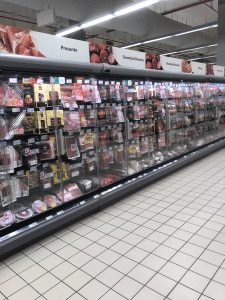
There are places where you really come out ahead in Portugal, especially with charcuterie and cheese. There are cases and cases of Portuguese cheeses, separated by region and type of milk, and there are an absolutey insane amount of types of ham and sausage. I’m not complaining, mind you – but it can be overwhelming sometimes.
Another thing there’s a weird amount of choice is yogurt. The supermercados typically have two or three complete aisles of it – who knew there were so many types?
There have been some treasure hunts to try and figure out if products are available and where they might be hiding in the stores, since the internal logic is not exactly what we’re used to. Take baking, for example – flour and baking powder are next to each other (there are also a lot more types of flour, like corn, sweet potato, chestnut, etc.). However, sugar is on a different aisle, and salt (once again, with a lot of varieties) is on a third.
There are some things that are rare, the most immediately important to us being Mexican ingredients. We’ve only seen Salsa Verde in El Corte Inglês, although luckily it’s available via mail order. Certain spices are really hard to source, too – crushed red pepper flakes require a visit to the Indian market.
Overall, the food is fresher, better quality, and much cheaper, but there’s definitely more energy expended in marketing.
 A Modern Odyssey - Expatriates in Iberia
this post made me hungry! I love different kinds of markets, can’t wait until I can explore yours with you! xoxo
LikeLike
Just wait for the canned fish post …
LikeLike
I love exploring different grocery stores while traveling/living abroad. This was an interesting experience through your post, thanks for sharing!
LikeLike