
One of the trickier things about moving to Spain hasn’t been the language, the bureaucracy, or even the humidity. It’s been the clock. Or more specifically: the meal clock.
“What time do we eat?” is a surprisingly complicated question here. In theory, the Spanish answer is beautifully structured with a schedule built over generations to balance hunger, heat, work, and social time. In practice? We’re still figuring it out.
In Portugal, normal mealtimes are lunch around 1:00 and dinner around 9:00, which is relatively late by international standards. But Spain took it a step further. We haven’t exactly cracked the code, but we’re getting there, albeit slowly and hungrily.
Spain is not a three-meals-a-day kind of place. Meals unfold in stages, stretching from early morning into the late-night hours. It’s a slow, steady graze. If you don’t know the rhythm, you’ll either miss the meal entirely or be the only person in the restaurant.
Theoretically, here’s how it works:
- Desayuno (Breakfast): 8:00–9:30
Light and functional. Coffee, maybe toast with tomato (tostada con tomate), or a small pastry. It’s fuel, not a feast. - Almuerzo (Second breakfast): 10:30–11:30
Yes, it’s real. Usually a bocadillo (small sandwich), another coffee, sometimes even a beer or vermouth. Think of it as the mid-morning morale booster. It’s very much a workplace tradition. - Comida (Lunch): 2:00–3:30 or later
This is the main meal of the day. Multi-course if you’re at a restaurant. Followed by rest. It’s not a coincidence that many businesses close in the afternoon, as it’s hard to write emails after a plate of arroz meloso and a half bottle of wine. - Merienda (Afternoon snack): 5:00–6:30
A bridge to get you to dinner. Often a pastry or small sandwich. Kids have it after school; adults use it to justify a coffee or a sweet at a café. - Cena (Dinner): 9:00–11:00
Lighter than lunch, supposedly. But it depends where you eat. At home, maybe it’s a salad or tortilla. At a restaurant, it can be a full-blown feast (if you’re still awake).
So… when do we eat?
I’d love to tell you that we’ve adjusted, that we eat like locals, and that our bodies are perfectly in sync with the Valencian day. But the truth is, we’re still somewhere between Spain and wherever our stomachs used to live.
- Lunch? I am usually ready to eat at 12:00 or 12:30, because I’m hungry. Kristie can typically go a little later, maybe as late as 1:30.
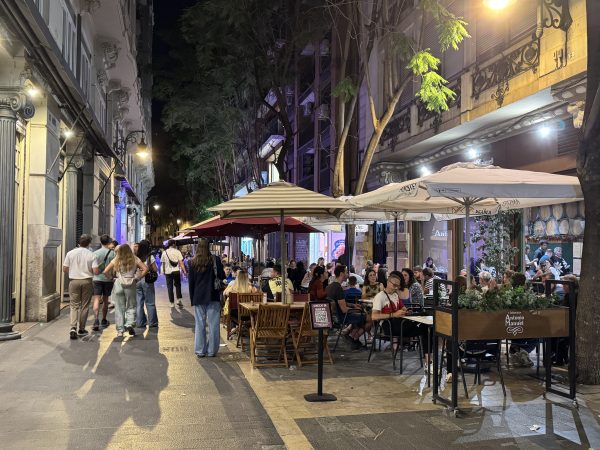
- Dinner? At home, around 7:30 – 8:00. If we go out, it’s 8:30 or 9:00, which sounds late to most Americans, but in Spain, it’s the early-bird seating. We’re often finishing up just as the real crowd starts arriving.
It’s partly a matter of habit, partly biology. We get hungry earlier. And while we’re up late most nights, going to bed with a full stomach is still tough.
Even when we have guests visiting and adjust our schedule to eat on their time, it’s often literally impossible to find a restaurant open before 8:00. Many places open later. We’ve wandered hungry streets at 7:45 only to find the staff still setting the tables.
Why are meals so late? Spain’s mealtimes confuse almost everyone on their first visit. But there are reasons for them.
Some are historical. Until 1942, Spain was in the same time zone as Portugal and Great Britain. Francisco Franco changed it during WWII to match up with his buddies in Nazi Germany (seriously), and no one ever changed it back. The time on the clock just doesn’t quite match up with the sun in the sky.
Others are cultural. Mid-afternoon heat makes a long lunch and late dinner more practical. A later workday (often 10:00–2:00 and 4:00–8:00) shifts everything forward.
And then there’s tradition. When everyone else eats at 10:00, it just something you do.
Another part of why this system functions is that life here is lived in public.
At 10:00 on a Tuesday night, the plazas are still full of people. Kids are playing soccer, couples are walking hand in hand, friends are out for drinks. There’s no rush to get home and close the blinds. The whole city pulses later, and the restaurants are right in the middle of it.
We’re not quite on local time yet, but we’re not tourists anymore either. Eventually, we’d love to fully adopt the Spanish rhythm:
- A big lunch in the middle of the day.
- A light snack in the evening.
- Dinner as more of a social thing than another full meal.
That’s the goal. That’s what our digestion wants, and our budget would probably appreciate it too. But then we walk into a restaurant at 8:45 and see a menu full of temptation… Suddenly, we’re ordering a bottle of wine and a plater of albondigas (meatballs).
We’re working on it.
So, the reality is that living here is about more than just addresses and paperwork. It’s about adjusting to the pace of life. For us, mealtimes are a big part of that.
We’re slowly syncing up with the rhythm around us. Until then, we’ll keep asking, “What time do we eat?” And then… eating a little earlier than everyone else.
But still, eating well.
 A Modern Odyssey - Expatriates in Iberia