

One of the absolute best things about living in Portugal (right after the people) is the wine. It’s fantastic. It’s affordable. And it was one of our regular pleasures for the five years we lived there.
Portuguese wine rarely makes a splash abroad, and there are two big reasons for that. First, production levels at most wineries are relatively low and often regional, which means a lot of great wine never makes it far from where it’s grown.
Second, the labels are almost exclusively in Portuguese. Since the Portuguese are extremely practical, this means the biggest export market is Brazil, where they don’t have to spend extra for translation. This leaves very little for the rest of the world. The result is that unless you’ve lived there, or really gone deep on Portuguese wines, you’ve probably never tasted most of them.
We were lucky. In five years, we only had two bottles that were actively bad. We tried just about everything, from big red blends to crisp whites, with an assortment of odd little regional wines. Most of it was good, some of it was extraordinary, and nearly all of it was under €8.
Our favorites were the reds from the Alentejo. These wines are lush and full of fruit, and went perfectly with food. But we were also drinking more Tejo wines by the end of our time there. We discovered a couple of wineries around Santarém and Tomar that had fantastic reds and whites at surprisingly low prices. I once bought a case of absolutely killer wine for less than €30!
Douro reds were always in the mix, of course, and we knew we could always rely on Alvarinho (aka Albariño in Galicia) for white wines. Crisp, bright, and just the thing for seafood or summer evenings.
So, when we moved to Spain, we wondered: how hard is this going to be to replace? Would we have to go hunting for hidden bottles from other regions to find something we liked? Would everything be twice as expensive as it should be?
We shouldn’t have worried. Spanish wine is excellent, and yes, it’s still reasonably priced. The styles are different, but there are a lot of familiar flavors, and in many cases it’s literally the same grapes under different names.
One of the things that surprised me was just how many grape varietals are shared across Iberia. They don’t always go by the same name, of course.
- Tempranillo is Spain’s signature red grape. In Portugal, it’s called Aragonez (in Alentejo) or Tinta Roriz (in the Douro), and it’s a major component in Alentejo wines.
- Albariño and Alvarinho are the same white grape, just separated by a border and a few hundred meters of misty vineyard.
- Garnacha (aka Grenache) shows up in both countries, especially in blends.
- Godello (Spain) is basically the same as Gouveio (Portugal).
Once you learn to translate, everything starts to feel a little more familiar. Which is helpful, because Spanish wine can feel a bit overwhelming at first since there’s more of it, more big-name regions, more label classification, and a lot more marketing.
Something that’s missing in the cross-border wine assortment is Portugal’s secret weapon, Touriga Nacional. This grape is a major component in a lot of Portuguese wines, and it doesn’t exist in Spain as such … but, there are a few Spanish grapes that share some characteristics, whether in flavor profile, structure, or their role in blending.
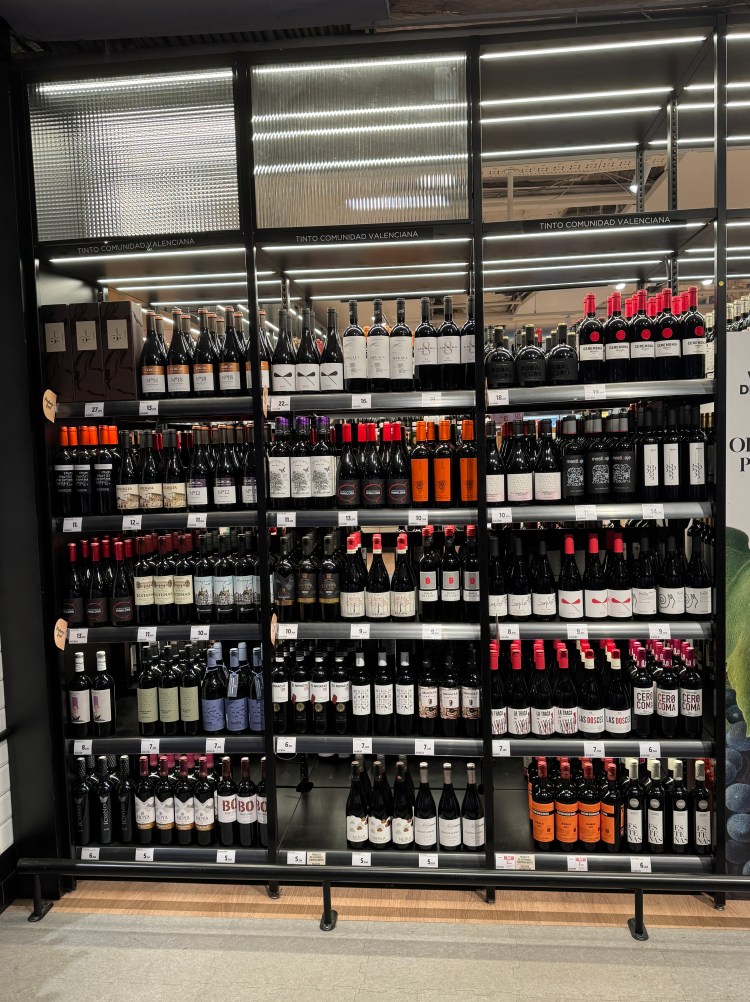
We’re approaching Spanish wine like we do everything else here: locally first. We’ve been focusing most of our attention on the wines of Valencia, especially the Utiel-Requena region just inland from the city. The key grape for reds here is Bobal. We had never heard of this grape before moving to Valencia, but we’re warming up to it quickly.
Bobal is juicy, earthy, medium-bodied, and often a little rustic in the best possible way. It’s the local pride and joy, and you can get really nice bottles for €6–10. It might lack the floral, lifted perfume of Touriga Nacional, but offers similarly dense fruit and good structure. There are also blends with Tempranillo, Cabernet, and Garnacha, and while they don’t always hit the elegance of Alentejo reds, they hit the comfort notes just fine. We’re lucky to have landed in the Spanish wine region that feels closest to what we left behind!
We’ve also started exploring Valencian whites, and one grape that shows up a lot is Moscatel de Alejandría. It’s the same variety as Portugal’s Moscatel de Setúbal, but it plays a very different role in Valencian wines. In Portugal, Moscatel is almost always rich and sweet, a full-blown dessert wine. But here in Valencia, it’s often used to make dry or off-dry whites, especially in the Marina Alta area.
The result is something light, floral, and slightly aromatic with just a touch of sweetness on the finish, but nothing close to syrupy. It’s easy-drinking, super refreshing, and surprisingly versatile with food. The Blanco Marina Alta by Bocopa is one of the more popular examples, and it’s become a household staple for good reason.
The reds, by the way, are never sweet, even when made from grapes that might suggest otherwise. Everything stays nicely dry and structured, with a focus on bold fruit and drinkability rather than sugar.
Another region we’ve really taken to is Ribera del Duero, which lies north of Madrid along – you guessed it – the Duero River (which becomes the Douro when it crosses into Portugal). The wines here are rich, structured, and full of dark fruit, often aged in oak for a bit of complexity. It’s basically Spanish Douro, and it feels like home.
The best part? Unless you’re chasing fancy producers, a great bottle still typically comes in under €12, and there are some for much less.
Now, this may be controversial, but … we don’t love Rioja. We respect it, since after all it’s one of Spain’s most famous wine regions. But the wines tend to be a little dry and a little too minerally for our tastes. They remind us more of Napa wines: big marketing, big oak, and a tendency to showcase the winemaking more than the fruit. It’s just not what we’re after right now.
A quick tour of some of the other players:
- Priorat (Catalonia): Bold, complex, age-worthy reds made mostly from Garnacha and Cariñena. The Garnacha Tintorera grape is actually the same as Portuguese Alicante Bouschet and Cariñena is the same as French Carignan, so there are a lot of friendly flavors for us here. We’ve had some spectacular bottles, but prices tend to be higher. Worth exploring when you want something special.
- Jerez (Andalusia): The home of sherry, which is its own whole universe. Some are dry and briny, others sweet and nutty. Not for everyday drinking (for us), but amazing with the right food.
- Penedès (Catalonia): The land of Cava, Spain’s sparkling wine. Made in the traditional method (like Champagne), Cava is surprisingly good at a shockingly low price. Great for brunch or just general sparkle needs.
What we’ve learned so far is that Spain has plenty of wine that fits our palate and our budget. The biggest shift has been learning the local names, finding new regions to trust, and figuring out which labels actually mean something.
We’ll always have a Portuguese soul. Our wine preferences were forged in the land of cork and codfish, but we’re finding plenty here in Spain to love, and with some great choices right in our own backyard. The wines are different, but the soul stays the same, and there’s always room to try something new.
The journey continues. With a little cheese, of course.
 A Modern Odyssey - Expatriates in Iberia