
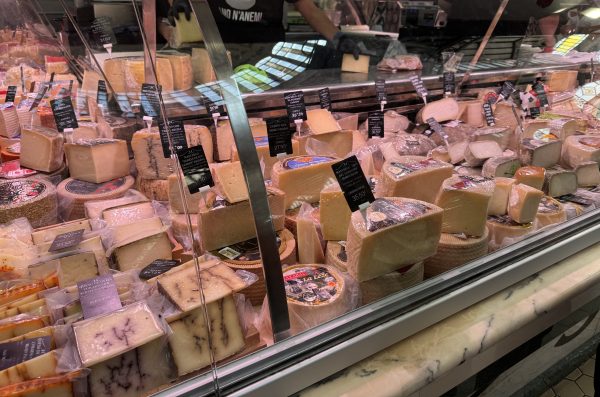
Let’s get one thing out of the way: I lived in Portugal for years, and I love Portuguese cheese. I do. From the soft and runny decadence of Serra da Estrela, to the salty firmness of São Jorge, to those lightly aged sheep cheeses that land somewhere between a custard and a dream, there’s some amazing stuff across the border.
But Spain?
Spain is on a whole other level when it comes to cheese.
Not just in quality (though that’s here in abundance), but in sheer variety. Spanish cheese is regional, seasonal, fiercely traditional, sometimes experimental, and often a little unexpected. And unlike wine, which gets more expensive and mysterious the deeper you go, cheese remains wonderfully accessible. It’s not fancy, it’s food.
You can walk into any market and find half a dozen cheeses you’ve never heard of, and if you’re lucky, someone behind the counter who will give you samples and tell you which one to pair with quince paste and which one with jamón. This is the joy of shopping in Valencia, and why cheese has become one of our favorite food categories to explore.
There are, quite literally, hundreds of Spanish cheeses. Every region has its own thing going on. Some are hard and flaky, others are so soft you need a spoon. Some are smoked, some are soaked in olive oil, and some are wrapped in herbs or wine-soaked leaves. There are cheeses made from goat’s milk, sheep’s milk, cow’s milk, and every combination thereof.
And we’re just getting started.
Let’s start with the headliner.
Manchego: The Cheese Everyone Thinks They Know
The most famous Spanish cheese by far is Manchego. It’s made from the milk of Manchega sheep in the La Mancha region, and it’s the cheese that launched a thousand tapas plates.
But if your only experience of Manchego is a few thin slices on a party platter, let me introduce you to its deeper complexity. Because Manchego isn’t just one cheese. It comes in different stages of aging, and they’re surprisingly distinct.
- Fresco (aged less than 2 weeks): Rare outside of Spain. Soft, mild, almost like a creamy brie.
- Semicurado (aged 3 months): Still tender, but with a bit of nutty sharpness.
- Curado (aged 6 months): Firmer, with a deeper flavor. A great “everyday” cheese.
- Viejo (aged 1 year or more): Crumbly, sharp, intense. Great with red wine and strong opinions.
Each stage tells a slightly different story. Manchego evolves from mild and milky to bold and almost crystalline with time. It’s kind of like a character arc for sheep cheese.
Idiazabal: Smoked Sheep, Sharp Personality
From the Basque Country and Navarre, Idiazabal is one of our personal favorites. Like Manchego, it’s a sheep’s milk cheese, but with a distinctly smoky note thanks to traditional wood smoking. It’s firm, tangy, a little wild, but still friendly. We often include it in our Thursday night “market plate,” where it pairs beautifully with sobrasada and a nice glass of vermouth.
Patamulo: The Sleeper Hit
This is a cheese that we first experienced at the Central Market. To be honest, I bought it because I liked the way it looked. It’s not especially famous, and you won’t find much written about it in English, but it’s incredible. From northern Spain, Patamulo is the kind of cheese that doesn’t shout for attention. It just quietly becomes your favorite. It is firm yet creamy, nutty and balanced, with just a hint of saltiness and a bit of mustiness from the rind.
Caña de Cabra: The Log We Love
This one’s a goat cheese, usually sold in a log shape (caña means cane). It’s got a soft and mellow chèvre-like center and progressively gets more creamy, intense, and mushroomy near the rind.

If you’re familiar with French Bûcheron or the American classic Humboldt Fog, you’ll feel right at home here. It’s that same line between freshness and funk, with a texture that spreads like butter when it’s warmed up just a little. Put it on toast. Put it under roasted figs. Put it on everything.
Cabrales: Not for the Faint of Nose
Yes, Spain does blue cheese, and yes, it’s strong enough to stand up to the likes of Stilton or Roquefort. Cabrales, from Asturias, is made from cow’s milk, or sometimes a blend of cow, goat, and sheep. When formed, it’s aged in limestone caves in the Picos de Europa mountains. The result is intense. Bold. Occasionally terrifying. But also deeply complex, with a punchy sharpness and that unmistakable blue tang.
Pro tip: Pair with a drizzle of honey or a sweet wine and watch it transform into something almost dessert-like. Almost.
Some days at the market, we pick something we know and love. Other days, we point at something unfamiliar and ask for a taste. Sometimes we buy it. Sometimes we nod politely and move on. Not everything is a winner; for instance, I really dislike Mahon, which is a very popular Spanish cheese. But part of the joy is that there’s always more to discover.
Now, this may be redundant, but I can’t write about cheese without mentioning Portugal again. As I said at the top: I still love Portuguese cheese. Serra da Estrela is world-class, and there are some gorgeous raw milk sheep cheeses in Alentejo and the North. But the fact is that Spain is playing in a bigger sandbox. There’s more experimentation, more regionalism, and, bluntly, just more cheese.
At this point, our fridge almost always contains at least three cheeses: a firm sheep’s milk cheese (usually Manchego or Idiazabal), a soft goat cheese (Caña de Cabra if we’re lucky), and something weird we’re trying out. Cheese has become a small weekly adventure. A sliceable, spreadable way of learning the country.
Because when you move to a new place, you start finding your way through food. And with Spanish cheese, the path is varied, delicious, and always a little bit funky.
 A Modern Odyssey - Expatriates in Iberia