
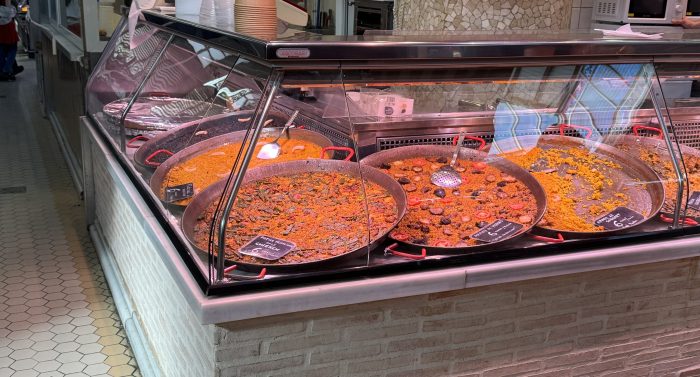
If there’s one food that feels truly of Valencia – grown here, cooked here, and argued about here – it’s rice.
Not just any rice. Paella. Or arroz al horno. Or arroz a banda. Or arroz negro. Or … well, you get the idea. Rice in Valencia isn’t a side dish. It’s a whole way of life, complete with rules, rituals, and the occasional heated debate about peas.
But before I get into all that, I need to confess something.
I didn’t grow up eating authentic paella. I grew up eating my dad’s version, which let’s just say was inspired by his travels in Spain. It had chicken and saffron and rice, yes, but it also had shrimp and sometimes clams, artichoke hearts, garbanzo beans, and green peas (I know). It was topped with Mexican-style chorizo that had been fried and drained, and then browned in the oven. It wasn’t faithful to any tradition, but it was delicious, and for me, it was the taste of family dinners, celebrations, and comfort.
Now that I’m living in Valencia, I swap the chorizo with sobrasada, preferably the picante kind. Still not what a Valencian grandma would make, but it hits the same nostalgic note, just a bit more local. However, I’m coming to understand just how seriously people here take their rice, and for good reasons.

Valencia isn’t just the birthplace of paella, it’s also home to the Albufera wetlands, a fertile region just south of the city that’s been producing rice since the Moorish era. The rice grown here, especially the short-grain bomba variety, is prized for its ability to soak up flavor while holding its shape.
The original Paella Valenciana wasn’t born by the sea, but in the fields. The first paellas weren’t topped with shrimp or mussels. They were peasant food, cooked over open fires by farmers using whatever was available:
- Chicken
- Rabbit
- Snails
- Flat green beans (ferraura)
- Large white beans (garrofó)
- A base of olive oil, paprika, saffron, and of course, rice
It was earthy, simple, and deeply tied to the land. No seafood. No peas. No lemons on top. And definitely no chorizo.
So how did seafood paella become the international face of Spanish cuisine?
Well, for one thing it photographs better. Prawns and mussels make a prettier travel magazine picture or Instagram post than rabbit and snails. And as the dish spread beyond Valencia, especially to coastal cities and tourist centers, cooks adapted it to local preferences, so seafood was a natural choice.

These new versions aren’t wrong, exactly. But they’re not Paella Valenciana, either. Here in Valencia, the distinctions are important. So important, in fact, that in 2012, the local government issued an official list of ingredients for the real thing. Peas didn’t make the cut.
And while we’re busting myths: I’ve also been told, officially speaking, that paella is a lunch-only dish.
This is one of those unofficial rules that traditionalists cling to like a life raft. Paella is heavy, they say. It’s for midday meals, especially on weekends. You eat it slowly, outside if possible, with friends and wine, followed by sobremesa and maybe a nap. Never for dinner.
But here’s the thing – I live in Valencia, and our favorite paella place is packed at night, and not just with tourists. Spanish families, friend groups, and locals who know exactly what they’re doing. So, I’m going to gently push back on this one.
If it’s 10:00 p.m., the rice is crisp on the bottom, and the wine is flowing, then yes, I’m eating paella for dinner. And I refuse to apologize.
Of course, it’s not just about paella. Valencia has an entire canon of rice dishes:
- Arroz al horno: baked rice with pork ribs, garbanzos, and morcilla (blood sausage)
- Arroz a banda: rice cooked in rich fish broth, traditionally served separately from the seafood
- Arroz negro: jet-black rice tinted with squid ink, savory and dramatic
- Fideuà: technically pasta, not rice, but a close cousin in the same culinary family
And in all of them, the goal is the same: to layer flavor into the rice, to let it absorb every bit of broth, spice, and oil, and to finish with that prized golden crust at the bottom: the socarrat. If you haven’t scraped your spoon across the bottom of the pan to find the crispy bits, you haven’t lived.
So yes, I’ll still make my dad’s version sometimes, with sobrasada in place of chorizo and a little artichoke on top. But I’ve also come to respect the original, cooked over flame, eaten with reverence, and always with an eye toward who you’re sharing it with.
Because that’s the thing about rice in Valencia: it’s never just about the food. It’s about land, time, people, and the place. And whether you’re cooking it in a pan in the fields or eating it at 10:00 p.m. in the middle of the city, what matters most is that the rice is good and the table is full.
 A Modern Odyssey - Expatriates in Iberia