

In my last post, I shared some of our early food discoveries in Valencia. Where to go for paella, tapas, tacos, and even a sushi place with go-go dancers. (Yes, really. If you missed that, it’s worth a scroll back just for the video.)
But there was one category where I intentionally held back: Italian food.
Why? Because it deserves its own spotlight.
We expected to find good Italian food in Valencia. After all, it’s a city with great taste and great weather, both of which tend to attract Italians. But what we didn’t expect was just how southern the Italian food scene feels here.
It’s not the delicate northern fare of Piedmont or Lombardy. It’s bold, rustic, and unmistakably Mediterranean. We’re talking polpette, arancini, and Grillo wine. Even the pizza feels like it was made by someone whose grandmother had strong opinions and a clay oven in the backyard.
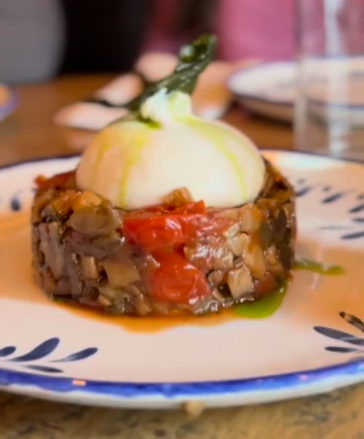
And the caponata? Let’s talk about the caponata.
It’s a dish we love. Slow-cooked eggplant with onion, tomato, capers, olives, raisins, and a bit of vinegar and sugar. Back in Lisbon, it was impossible to find. If we wanted it, I had to make it myself, which required a bit of planning and the willingness to stand over the stove for a couple of hours.
But here in Valencia? We found it around the corner, served as a starter with a generous burrata cheese on top. Caponata con burrata. Let that sink in for a second.
And this isn’t a one-off. The menus here seem to tilt toward the flavors of Sicily and Southern Italy more than the truffle-oil-and-polenta cuisine of the north. We’ve spotted arancini, stuffed and fried rice balls. Polpette, or fried meatballs, show up in tomato sauce, often without spaghetti (which is, frankly, correct). And the wine lists frequently include Grillo, the crisp, aromatic white from western Sicily, nestled right next to the Verdejo and Albariño.
The flavors feel natural here. Like they belong. So… why is this? Why does southern Italian food feel so naturally at home in eastern Spain?
The answer lies – surprise, surprise – in history.
Valencia and Sicily aren’t just neighbors across the sea. They’ve been cultural cousins for over two thousand years. Both were Roman provinces. Both came under Islamic rule for centuries, and both absorbed the agricultural and culinary advances that went with it. You can still taste that today in the shared use of saffron, rice, citrus, almonds, and eggplant.
But the real connection kicked in during the Middle Ages, when both Sicily and Valencia were ruled by the Crown of Aragon. In the 13th century, Sicily became part of the Aragonese holdings (after the dramatic Sicilian Vespers rebellion), and Valencia had just been reconquered from Moorish control and folded into the same kingdom. From that point on, Aragon ruled a Mediterranean empire that stretched from the Iberian Peninsula and the Balearic Islands through Sardinia and Naples all the way to Sicily.
This wasn’t just a political arrangement. People moved. Goods moved. Recipes moved. And the flavor profile of the Mediterranean began to blur in the most delicious ways.

(By Holger Uwe Schmitt – Own work, CC BY-SA 4.0)
Fast forward a couple of centuries and enter the Borgias, one of Valencia’s most infamous exports. Rodrigo Borgia (later Pope Alexander VI) and his extended family held land, power, and enormous influence across Naples and Southern Italy. They weren’t just eating Italian food. They were probably telling cooks what to make. (Possibly with threats.)
Later still, Sicily and Naples came under the rule of the unified Kingdom of Spain, forming part of the Kingdom of the Two Sicilies. They remained culturally and politically tethered to Spain well into the 19th century. That meant continued connections in language, law, and culture, including what was being cooked and eaten.
So, when you order caponata in Valencia, you’re not encountering fusion. You’re tasting a shared Mediterranean heritage that’s been simmering for over 700 years. You’re looking at centuries of shared history, trade, and cross-cultural cuisine. It just makes sense here.
And the best part? You can enjoy it all without even leaving your neighborhood.
Our top three Italian spots so far:
- La Pizza – for the aforementioned caponata & burrata love affair, plus very solid pizza.
- Le Favole – La Pizza’s sister restaurant with an emphasis on pasta. A cozy atmosphere and the kind of sauces that make you want to write a thank-you note to the chef.
- Latte & Farina – handmade pasta, perfect portions, and the kind of service that makes you feel you should stay for dessert (which is, in fact, a good idea).
There are plenty more, and we’re still exploring. But one thing’s already clear: Valencia doesn’t just host good Italian food, it understands it. There’s a kindred soul here, shaped by saltwater, sunlight, and shared empires. It’s the Mediterranean talking to itself across time. And lucky for us, we get to listen, with a fork in hand.
 A Modern Odyssey - Expatriates in Iberia