

We’ve just returned home from a round-trip road trip from Lisbon to Valencia.
We had several goals in mind:
- Get our Padrón, the registration with the local authorities that every foreigner must file as part of the residency process.
- Transport a carload of our most fragile belongings – glassware, ceramics, and other items that might not survive a moving truck.
- Investigate kitchen solutions in Valencia. Our soon-to-be home has space for a pantry cabinet and a center island, and we wanted to see if we could find something that would work for us.
- Get a clear idea of what our actual moving-day drive will look like. Spoiler alert: we learned a lot.
According to Apple Maps, the fastest route takes about nine hours. We left Lisbon at 06:30 on a Monday morning and crossed into Spain by 09:00, which instantly became 10:00 thanks to the magic of time zones.
Up to Mérida, we enjoyed smooth sailing on modern freeways. I have to say: Portuguese autoestradas are a cut above. They may be toll roads, but they’re clean, consistent, and well-equipped, with fuel stops and cafés (and big, clean bathrooms!) every 45 km or so. Spanish highways? Less toll roads, but less predictable. You’ll still find gas stations, but not all have food available. Even when there are attached cafés, they’re hit-or-miss – and some bathrooms should come with a hazard warning.
After Mérida, the map steered us onto an “N” road. This is Spain’s national highway system, which typically means a two-lane road with occasional passing zones. At first, we meandered through small towns, slowing to 40 or 50 km/h with every village. But as the towns dwindled and the pavement got bumpier, we found ourselves occasionally funneled onto “C” roads, which are essentially country lanes, and it became even more desolate. This kept up for close to 300 km. Eventually, we rejoined a major freeway, but the lesson was clear: quickest route does not mean best route.
Next time, we’re going through Toledo. It adds around 100 km to the journey, but only about 20 extra minutes – and the entire route is proper highway, save for a small stretch.
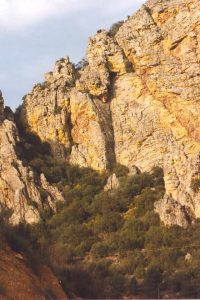
That said, the scenery along the back roads was beautiful. Much of rural Spain reminded me of inland California. Rolling golden hills speckled with oaks, and the occasional stretch of pine forest at higher elevations. The crown jewel was Puerto Peña, where rocky mountains tower over a serene, man-made lake. Stunning? Absolutely. Would we go again? Probably not. Although it’s breathtaking, it’s nowhere near anywhere we would foreseeably be.
Our stay in Valencia was brief—just two full days—but productive. We’re now officially registered (empadronados!), ready for the next phase of bureaucracy when we return in July. We did a little scouting for kitchens, but weren’t able to find exactly what we wanted, so that’s still pending, but we had a nice couple of days wandering around, punctuated by some excellent dinners.
For the return trip, we decided to slow down and play tourists. Mérida, about two-thirds of the way home, had been on our bucket list for ages. So, we booked a hotel and made a proper stop.
What a place! This was Augusta Emerita, a major Roman city, and the heritage is jaw-dropping. There’s a Roman theatre, amphitheater, hippodrome, a fantastic museum of Roman art (the tile floors are museum stars in their own right), and even a Moorish alcazaba for good measure. It sits along the wide Guadiana River, adding a bit of green to the gold-and-stone aesthetic.

And here’s a travel pro tip: we stayed in a five-star hotel right on the plaza for only €15 more than we paid at a budget hotel in Valencia. Not only was the hotel elegant, but we had a truly excellent dinner in town.
Only downside? It was 38°C (101°F), which made sightseeing feel like a slow roast. We had to duck back into the air-conditioned hotel, so we didn’t see everything there was to see, which is a pity. I highly recommend Mérida, but don’t go in high summer unless you really enjoy solar cooking.
Anyways, we’re now back in Lisbon until the actual move. Lexie the Cat was pleased to see us when we returned – luckily, she is utterly unaware of the impending disruption to her life.
 A Modern Odyssey - Expatriates in Iberia