
One of our major motivating factors in deciding to move to Europe was our love of traveling. We always envisioned regular excursions from our home base. There were so many places we wanted to see, but trips from the US had to be huge, concentrated affairs – but if we LIVED in Europe, nothing was more than a few hours away by plane, so it would be possible to do trips without losing four days getting there and back.
So, we moved to Portugal – and then, COVID.
We really haven’t had the opportunities that we thought we would during the first year we were here. Other than visiting Lisboa as part of the house-hunter adventures and a one-night stay in Bragança, we’ve only had a few day trips to areas surrounding Porto.
However, things are finally starting to open back up – and we both have both our vaccines, so we feel safer – and Sunday we were both really tired of looking at the walls of our apartment! We decided it was time for an adventure, so we hopped in the car and drove to Conímbriga.
Some background: the city of Coimbra is just a bit more than an hour south of Porto. We’ve visited it on past vacations here, and it’s a fascinating old place. The oldest university in Portugal (and one of the oldest in the world) is located there, and there’s a marvelous hotel at Quinta das Lágrimas where Inés Castro was murdered to prevent her from marrying Pedro the prince (when he finally became king, he had her exhumed, officially crowned as his wife, and forced the nobility to kneel and kiss her dead hands).
But Coimbra is only the new town – the original was Conímbriga, a few miles away. It was first settled as a Celtic oppidum (fortified town) as early as 1000 BCE. The Romans conquered it as part of their annexation of Lusitania around 140 BCE, and because of its good location along the Via Publicae that went from Lisboa to Braga it grew quickly in size and importance.
The town’s Forum was first dedicated to Augustus, then Claudius, and then totally rebuilt under Vespasian.
The Roman city thrived for over 500 years until the Empire lost its hold on Iberia to the various German tribes. The Swabians sacked the town in the 460s, and it was on the border of the northern kingdom of Galécia and the southern Visigothic kingdom of Toledo until the Moors invaded in 711, when the town was abandoned.
Anyways, we knew Conímbriga was there, and had always intended to visit, and this seemed like the perfect opportunity, so off we went. Getting there was simple, although I was glad it was a Sunday and the town of Condeixa-a-Nova was more or less closed – I can see those narrow streets being a nightmare during the week!
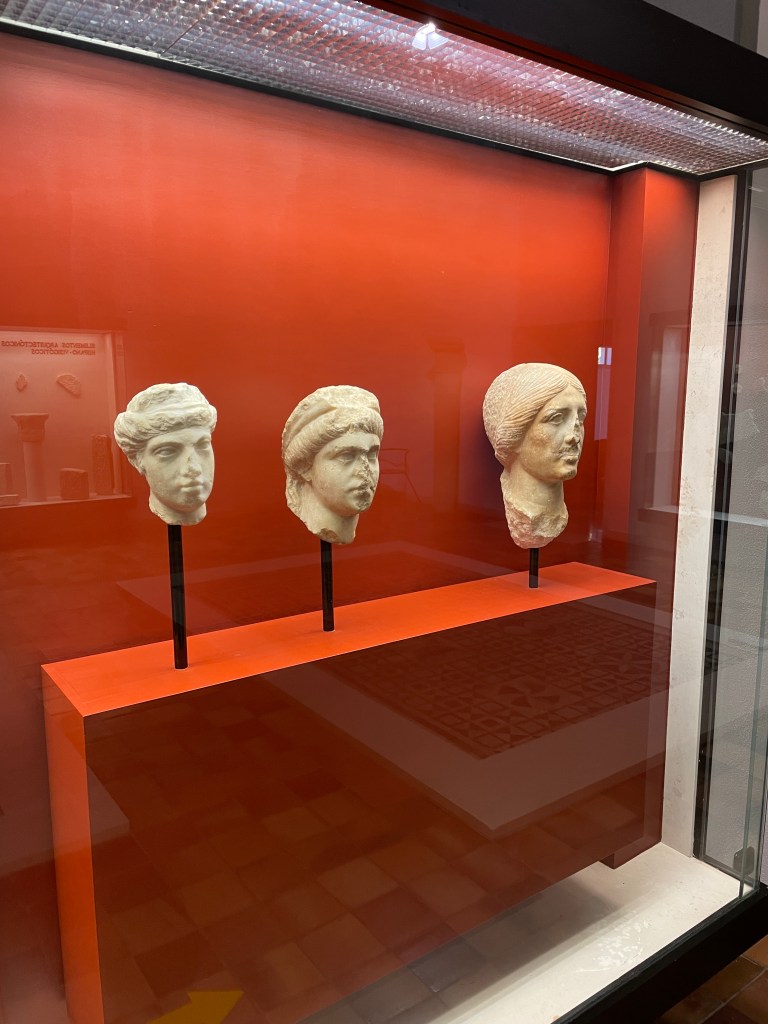
I have to say, we didn’t have super high expectations, so we were very pleasantly surprised with what we found when we reached the site. There is a very nice little museum with signage in Portuguese and English where some of the artifacts gleaned from the excavations are displayed in a way that provides good context for the whole.
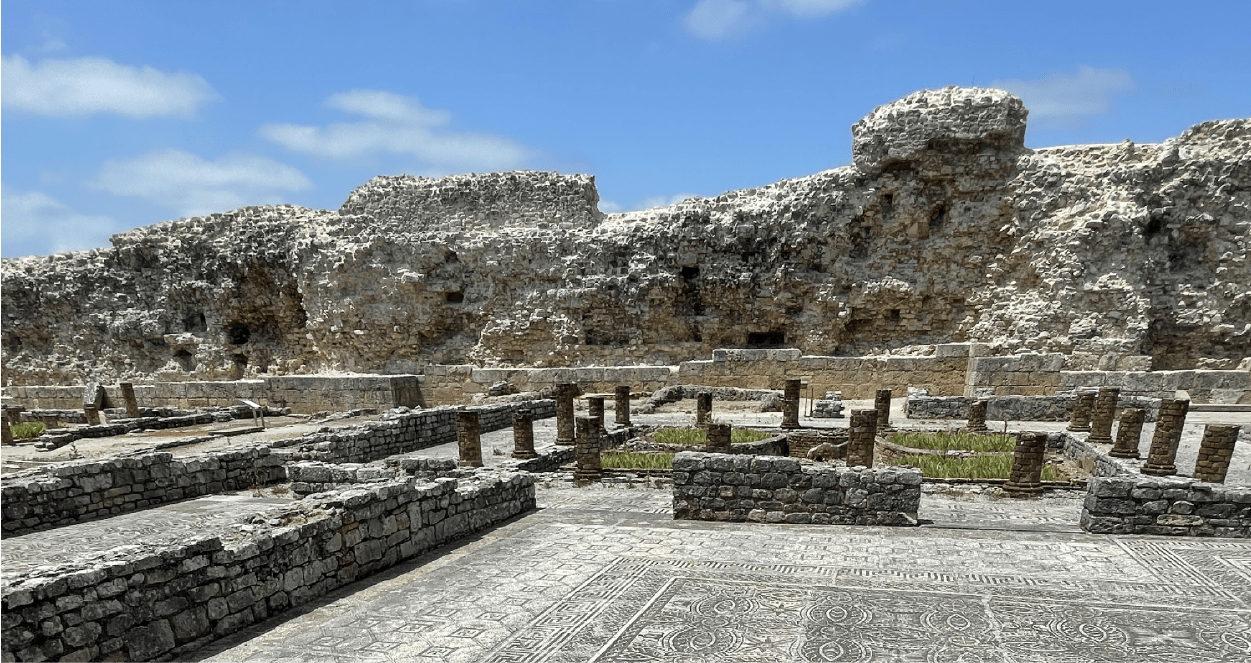
The most surprising thing is the size of the ruins. There are literally acres of buildings. You can clearly see walled gardens, the rooms of individual shops and houses, and the massive baths.
There’s part of an amphitheater, although it was somewhat torn down for building materials in the later days of the Roman town to put up some massive walls. There’s also not much left of the Forum – all that nice marble got scavenged to be used in Coimbra!
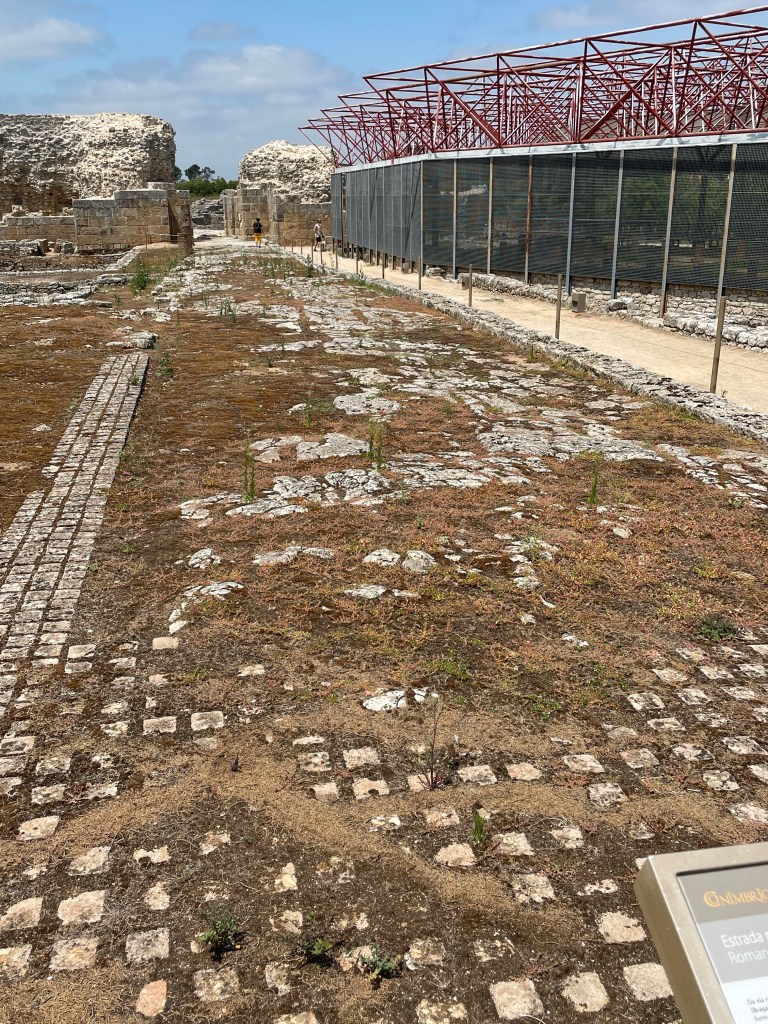
Something that I found particularly thrilling is that the Roman road is still very evident – AND you get to walk on it! I also think it’s pretty interesting to consider that this town was so important for so long – we’re talking about a stretch of time equivalent to that of from Shakespeare to now – and think of everything that’s happened during those years!
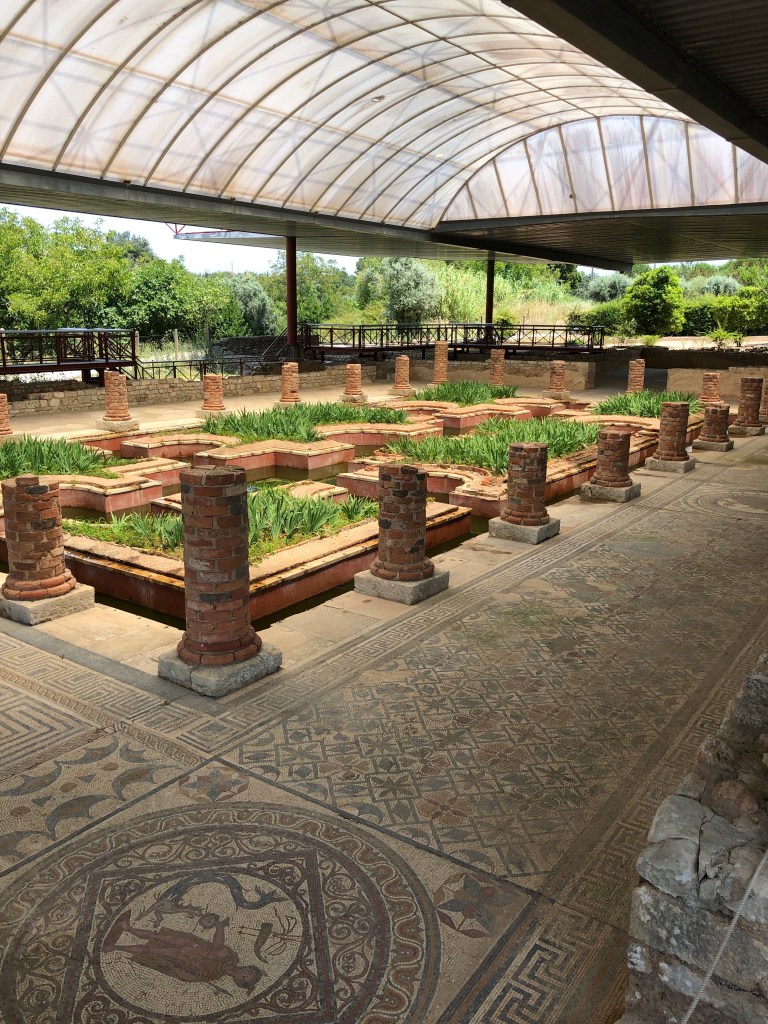
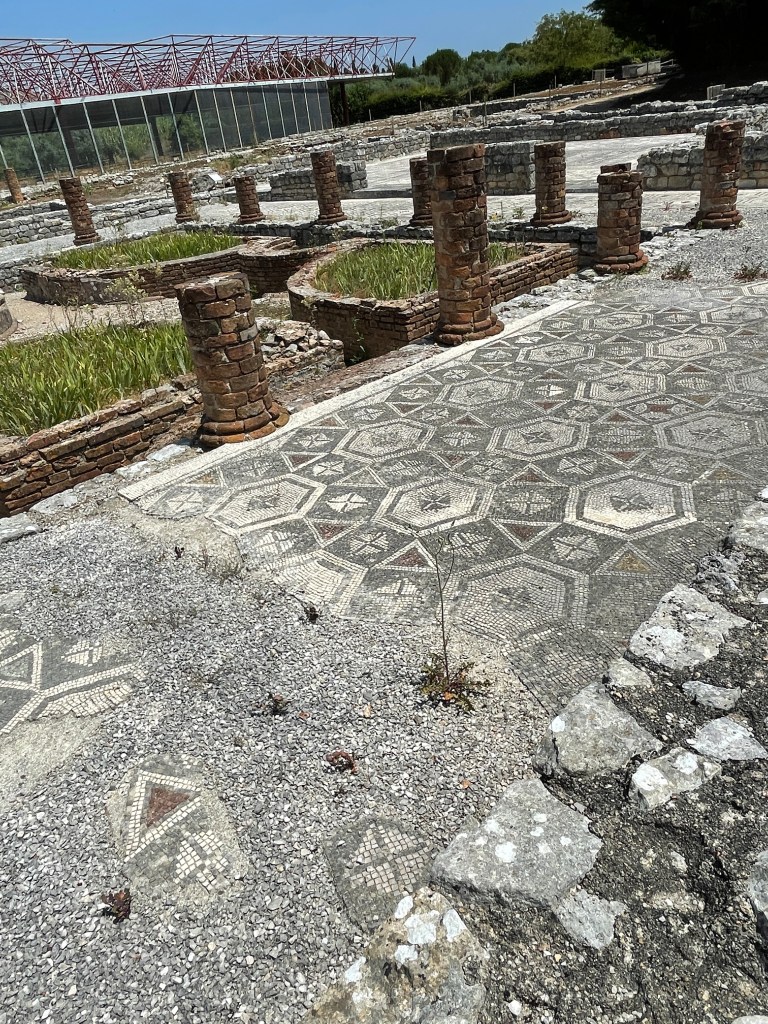
One section of the site is covered, which provided a nice break from the sun. This area was one of the towns large homes, and they’ve re-engineered the water features in the central peristyle garden. What’s really cool is that a lot of the original mosaics are still in place, and in amazingly good condition. You can really get a feel for what an up-scale Roman home felt like.
If you find yourself anywhere in the Coimbra area, I highly recommend a trip to Conímbriga. Give yourself a couple of hours, and be prepared to lose yourself in history!
 A Modern Odyssey - Expatriates in Iberia